Table Of Content

In the special factory for this brand we will have them differentiate and get the exact object to instantiate and also how to instantiate it . Abstract Factories are great for supporting multiple platforms while keeping your code-base unified. Suppose you have a large Qt or GTK+ or .NET/Mono program that you want to run on Windows, Linux, and OSX. But you have a feature that is implemented in a different way on each platform (perhaps via the kernel32 API or a POSIX feature). You can add more products to your factory by adding new products, which implement interface exposed by Factory Method. In absence of Abstract Factory, Client needs to know details of concrete classes.
Software Design Pattern in Development
The Abstract Factory Pattern solves a major crisis for the need to write clean code. We have covered the basics of this pattern and also understood the implementation using an example. The Abstract Factory Pattern can be used very effectively for closely related families of different products unlike the Factory Pattern, which can be used only for a single type of product. Assume that you are designing a family of two products (a browser and a messenger). AbstractProductThe abstract product is an abstract class and as expected it defines a family of products that inherit from it. In this example, the abstract product is aDoorHandle, I added a function that prints something for the purposes of showcasing.
Fashion Camp
The Abstract Factory Pattern is a way of organizing how you create groups of things that are related to each other. It provides a set of rules or instructions that let you create different types of things without knowing exactly what those things are. This helps you keep everything organized and lets you switch between different types easily, following the same set of rules. The client shouldn’t care about the concrete class of the factory it works with.
Implementation

Abstract Factory design pattern is one of the Creational patterns. Abstract Factory pattern is almost similar to Factory Pattern except the fact that its more like factory of factories. AccountFactory is a class that implements the Factory design pattern. It uses the accountType to create the corresponding type of BankAccount.
Abstract Products (Car and CarSpecification interfaces)
It is a Creational pattern which allows you to create generation 2 in a simple place. It conforms SRP and OCP - all changes are made in a single class. Broadband, phone line and mobile for instance and you're asked to create an application to offer their products to their customers. I want to provide code examples, because I think combining the examples from the top two answers in this thread will give a better demonstration than either answer alone.
The quote assumes that an object is calling its own factory method here. Therefore the only thing that could change the return value would be a subclass. Now with regards to that quote, how exactly does the Abstract Factory pattern delegate the responsibility of object instantiation to another object via composition? It looks like the Abstract Factory pattern also uses inheritance to do the construction process as well in my eyes, but then again I am still learning about these patterns. It easy, imaging that you have a code that works with the abstraction, you should create abstractions and not concrete classes. For example, to add a new product type to the app, you’ll only need to create a new creator subclass and override the factory method in it.
services
The subclass then inherits most of the code from the base class, but, thanks to the factory method, can render Windows-looking buttons on the screen. But what creates the factory objects if the Client is only exposed to the abstract interfaces? Typically, during initialization, the application creates a concrete factory object, which is then passed as an argument to the Client’s method that creates products (s).
Variants
A class may be configured with a factory object, which it uses to create objects, and the factory object can be exchanged at runtime. Now let's explore the ways to implement the Factory design pattern together. From the class diagram, coders can easily see that the implementation for Factory is extremely straightforward.
The Client’s code will use both factories and products through their abstract interfaces to start making a product that belongs to a certain family. This allows us to change the type of factory that we pass to the Client‘s code, as well as the product variant, without breaking the existing implementation. Abstract Factory is a creational design pattern, which solves the problem of creating entire product families without specifying their concrete classes.
How to use the flyweight design pattern in C# - InfoWorld
How to use the flyweight design pattern in C#.
Posted: Wed, 08 Jan 2020 08:00:00 GMT [source]
Next, we will write the factories that will create the products. In the above examples, we wrote the Cheese interface, which is an AbstractProduct. Then we wrote the GoatCheese and MozzarellaCheese classes, which are the ConcreteProduct to implement Cheese. Similarly for the pizza sauce, we wrote the Sauce interface and the TomatoSauce and CaliforniaOilSauce implementation classes. In a similar sense, a common class such as an Employee might branch out to several more concrete classes. An abstract class is partially implemented and defines the requirements that its child classes should have and some generic child behavior as well as what functions they should have.
Based on the diagram above, let's go through the implementation of this design pattern together. What I've done here is create some slightly atypical examples of the two patterns and tried to make them appear at first glance quite similar. This will help to pinpoint the crtical differences that separate them.
Our designers have proven themselves to be able to surpass European & American market expectations. We show this with our innovative styling & embellishment of our copyrighted prints. In 1930, Kepes settled in Berlin, where he worked as a publication, exhibition, and stage designer. Around this time, he designed the dust jacket for Gestalt psychologist Rudolf Amheim’s famous book, Film als Kunst (Film as Art), one of the first published books on film theory. In Berlin, he was also invited to join the design studio of Laszlo Moholy-Nagy, the Hungarian photographer who had taught at the Dessau Bauhas. When, in 1936, Moholy relocated his design studio to London, Kepes joined him there as well.
Probably the most obvious and convenient place where this code could be placed is the constructor of the class whose objects we’re trying to reuse. However, a constructor must always return new objects by definition. Subclasses can alter the class of objects being returned by the factory method. Also, you don’t want to change existing code when adding new products or families of products to the program.
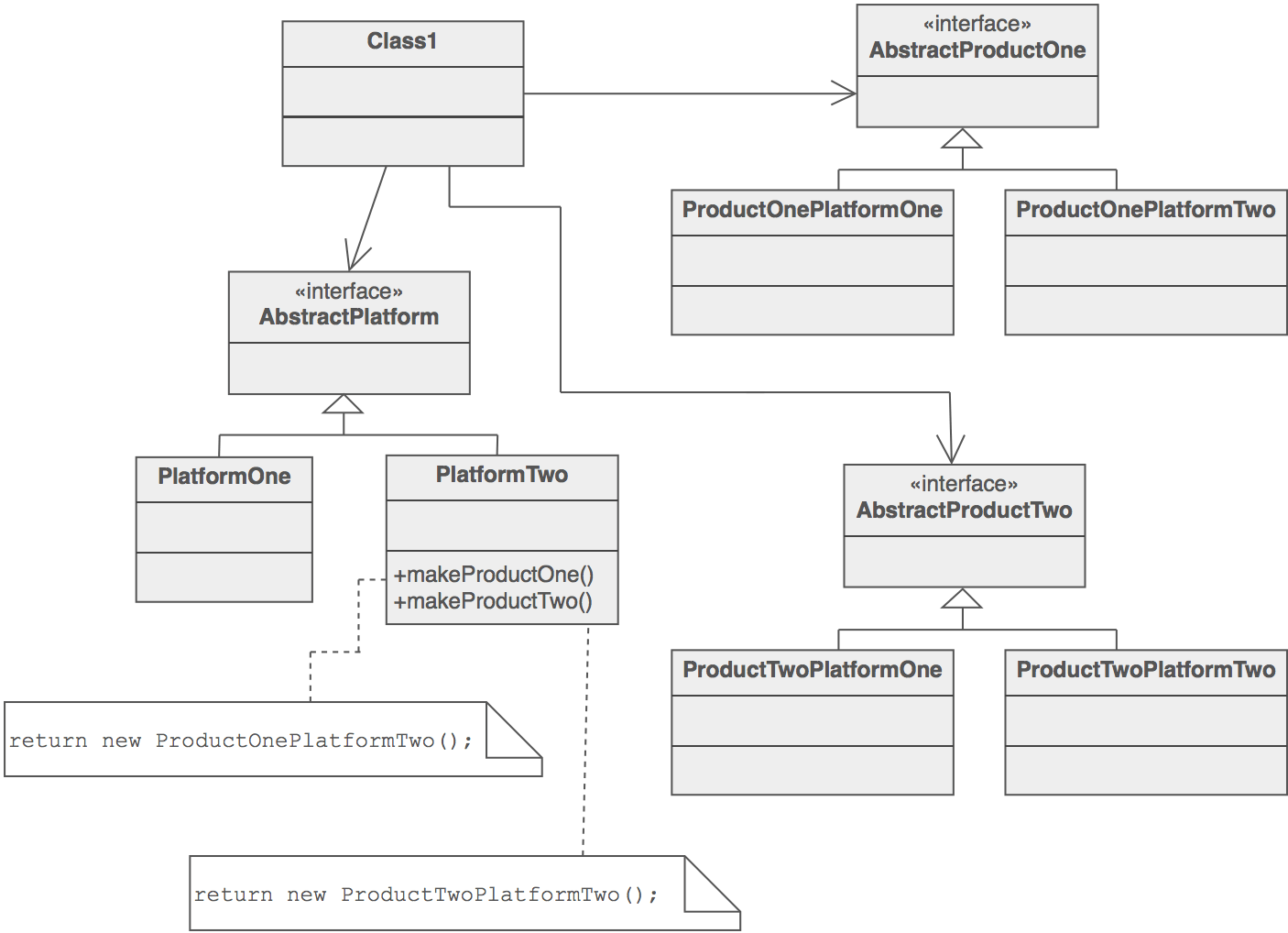
Another difference is that the factory method pattern uses inheritance while the abstract factory pattern uses composition. We say that that factory method uses inheritance because this pattern relies on a subclass for the required object instantiation. On the other hand, the abstract factory pattern delegates responsibility to a separate object (abstract factory) dedicated to create a family of related objects. Then, through composition, the abstract factory object can be passed to the client who will use it (instead of factory method) to get the family of related objects.
You just create a new concrete factory class and pass it to the client code. The Factory Design Pattern in C++ involves using a base class or interface with a virtual method for creating objects. Derived classes can override this method to create different object types based on client requirements. This pattern promotes flexibility and extensibility by letting subclasses decide which class to instantiate. It simplifies object creation without needing to know specific types, making code modular and easier to maintain. Additionally, it enables the creation of complex objects that may be challenging to create manually.


No comments:
Post a Comment